
Data and Solutions for CER Directive
Data and dashboard for risk analysis, risk assessment, and risk management for critical entities and their supply chains, aligned with the requirements of the EU’s Critical Entities Resilience (CER) Directive.
Meet regulatory requirements for compliant operations efficiently and with confidence using reliable data and purpose-built analytical tools.
CER Directive at a Glance
- The Critical Entities Resilience (CER) Directive was adopted by the European Union in December 2022.
- Objective: Strengthen the physical resilience of critical entities that provide essential services in respect of all hazards, such as natural hazards, epidemics, hybrid warfare, and war (all-hazards approach)
- Background: In light of global crises, natural disasters, geopolitical tensions, terrorism, and sabotage, protecting critical entities has become an increasingly important challenge for governments and operators alike.
- Complements the NIS2 Directive, for cybersecurity. Takes in account all types of hazards
Next Steps – What Organizations Need to Do Now
- The CER Diective is now in force. Compliance with its requirements is an operational prerequisite for designated critical entities.
- Risk Analysis and Risk Assessment:
Operators must identify and assess risks that could disrupt the provision of essential services, including dependencies on other operators, sectors, and countries - Resilience Measures:
operators must demonstrate that appropriate resilience measures have been implemented
How We Support Compliance
We have extensive experience in political risk data and early-warning indicators for risks such as armed conflict, terrorism, sabotage, and sanctions affecting supply chains. Based on these political risk datasets and additional risk indicators, we have developed a dashboard following an all-hazards approach. It helps organizations meet regulatory requirements for risk assessment, risk management, and documentation while reducing the effort involved in compliance activities. Our solutions are built on consistent, transparent, and reliable data, enabling evidence-based decision-making and auditable risk management processes.
Risk Assessment
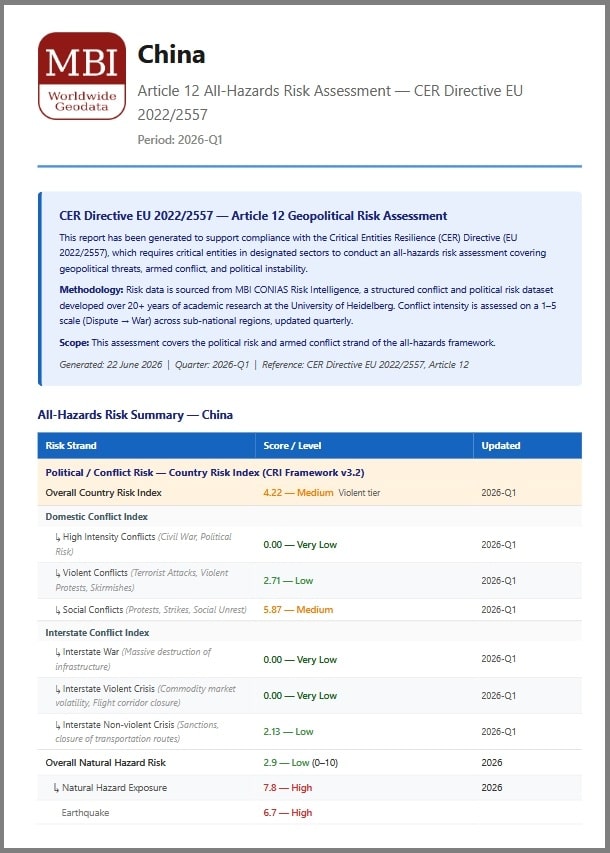
The dashboard includes a feature that automatically generates a Country CER Report for use in assessing risks to company locations, subsidiaries, suppliers, and other business partners. Relevant locations can be uploaded via a CSV file and analyzed immediately. The report covers key risk categories at the country level and applies a standardized methodology, enabling consistent comparisons across countries.
A core component of the CER Report is the Country Conflict Risk Index, which provides an overview of a country’s political and security risk environment. For example, it includes early indicators of an increased risk of terrorism and sabotage—key risk factors for the operation of critical entities. The index synthesizes political conflicts and geopolitical tensions into a transparent country risk score, taking into account both domestic and interstate conflicts, as well as their intensity, persistence, and potential for escalation. This enables operators of critical entities to quickly identify and prioritize countries and locations with an increased ned for resilience measures.
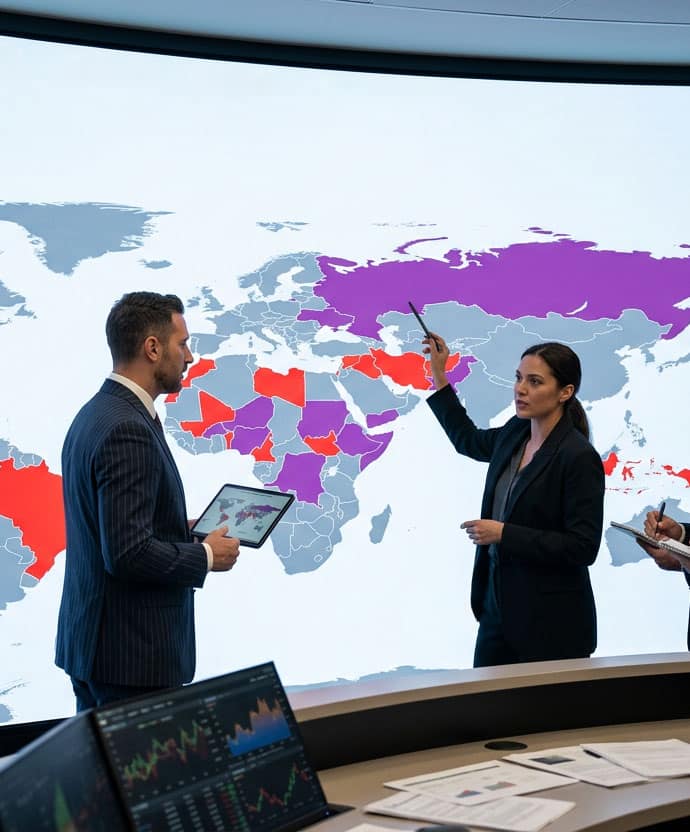
For more detailed analysis, the underlying conflict data can be explored at a subnational level, providing insights down to regional geographic units.
Proactive Risk and Crisis Management
Create Scenarios: Critical entities are required to implement resilience measures and maintain contingency plans for a range of disruption scenarios. Our political risk data and analytics platform support the development of realistic scenarios involving politically motivated violence, including terrorism, civil unrest and war.
Assess the Likelihood of Scenarios: The conflict analysis underlying the Country Conflict Risk Index provides detailed insight into the specific developments and risk drivers relevant to each scenario. Under the ‘trends’ tab in the dashboard, you will find a security forecast showing the expected intensity changes at the subnational level over the next three months. These deeper insights on a granular level help organizations assess the likelihood of crisis events and strengthen preparedness planning.
Supply chain security
To ensure continuity of operations, critical entities are required to assess not only risks to their own facilities but also risks arising from suppliers, service providers, and business partners. Organizations are expected to:
- Identify their critical suppliers
- Integrate CER requirements into supplier contracts and
- Plan alternative supply chains.
Identifying Critical Suppliers: Using the Country CER Report and scientifically grounded risk methodologies, organizations can quickly identify where employees, production facilities, transportation routes, and supply chains may be exposed to current or emerging risks.
Planning Alternative Supply Chains: Alternative suppliers and transportation corridors should ideally be located outside the same geopolitical risk and escalation zones in order to reduce systemic dependencies. CONIAS conflict data helps visualize and assess these relationships, supporting more resilient sourcing and logistics strategies.

Key Differentiators
Globally consistent and comparable data

AI-ready, high-quality data

Individual consulting and support

Continuous updating after every release

100 % GDPR compliant
TELL US WHERE YOU ARE HEADING.
WE WILL GLADLY ASSIST YOU IN SELECTING THE DATA NEEDED TO REACH YOUR GOAL.
Didn’t find what you are looking for or have another question? Please do not hesitate to contact us!
Our experts will be happy to advise you individually and without obligation on which data you can use to create added value for your company and realize savings.
Would you like to evaluate and visualize the data?