News | Purchasing Power | Socio-Demographics
Europe Market Data Release 2026: High-Precision Geodata for Advanced Location Intelligence
03/11/2026
MBI Geodata has released the latest update of its European Regional Market Data, delivering newly revised, fully harmonized geodata across Europe. The latest edition provides businesses with detailed, internationally comparable indicators at administrative, postal, and microgeographic levels, creating a powerful foundation for geomarketing, expansion planning, and advanced location intelligence.
Key Indicators Available Across Europe
The 2026 European release includes a broad portfolio of internationally standardized indicators designed for cross-border comparability.
- Consumer Spending: Detailed expenditure data across 20 product and service categories. Ideal for retail analysis, demand forecasting, and sector-specific potential assessments.
- Purchasing Power: A core indicator for evaluating regional consumption potential.
- Sociodemographics: Including age bands and unemployment to support target group profiling and regional comparisons.
- Income Quintiles: Granular distribution insights that help identify affluent segments or price-sensitive markets.
- Education: Classification by qualification level for workforce analysis and regional talent assessments.
- Households by Type: Segmentation based on household composition to refine marketing strategies.
- Marital Status: Additional demographic depth for advanced segmentation models.
All indicators are developed using harmonized methodologies, ensuring reliable comparisons across countries and reducing inconsistencies in international analyses.
Pan-European Coverage with Micro-Level Precision
The strength of MBI’s European Market Data lies in its exceptional spatial depth combined with methodological consistency. The dataset is available at multiple geographic levels, ranging from administrative regions to highly granular postcode and microgeographic units. This flexibility allows analysts to adapt their evaluation exactly to their business model, industry requirements, and market strategy.
Across Europe, the update offers remarkable regional detail. Examples from the 2026 release include:
- Spain: Consumer Spending at Municipios level for 8,132 areas
- Poland: Sociodemographics at 5-digit postcode level for 20,457 areas
- Romania: Purchasing Power at 6-digit postcode level for 38,246 areas
- Italy: Income quintiles at Sezioni di Censimento level for 748,306 areas
- Türkiye: Education at Mahalle level for 50,595 areas
This level of granularity supports highly accurate micro-location analysis, allowing businesses to move beyond broad regional assumptions and base decisions on precise local realities.
Example Insights from Consumer Spending
The analytical power of the data update becomes particularly visible when looking at real urban examples.
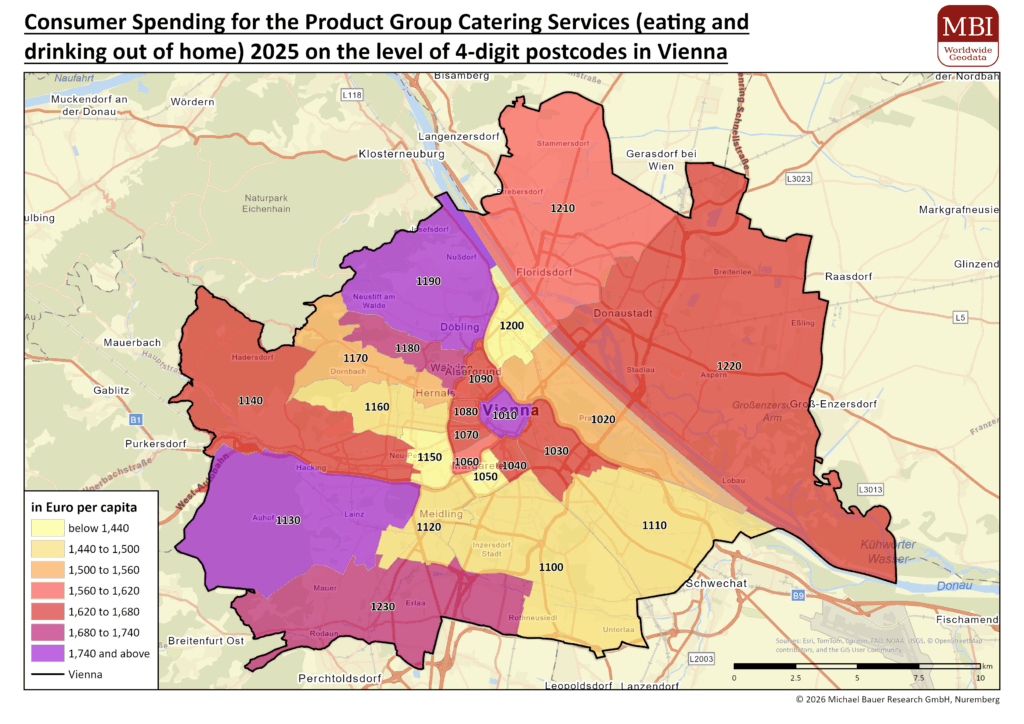
In Vienna, Consumer Spending on Catering Services, meaning eating and drinking outside the home, is available at the level of 4-digit postcode areas. This allows businesses to pinpoint exactly which parts of the city show the highest demand for restaurants, cafés, and food service concepts. Instead of relying on city-wide averages, planners can identify specific high-potential zones and align expansion strategies accordingly.
A similar level of insight is available in Greater London. Consumer Spending on Clothing is provided at postcode sector level, offering a detailed view of local retail potential and purchasing behavior. Retailers and brands can clearly see where fashion expenditure is concentrated and where market saturation may already be high.
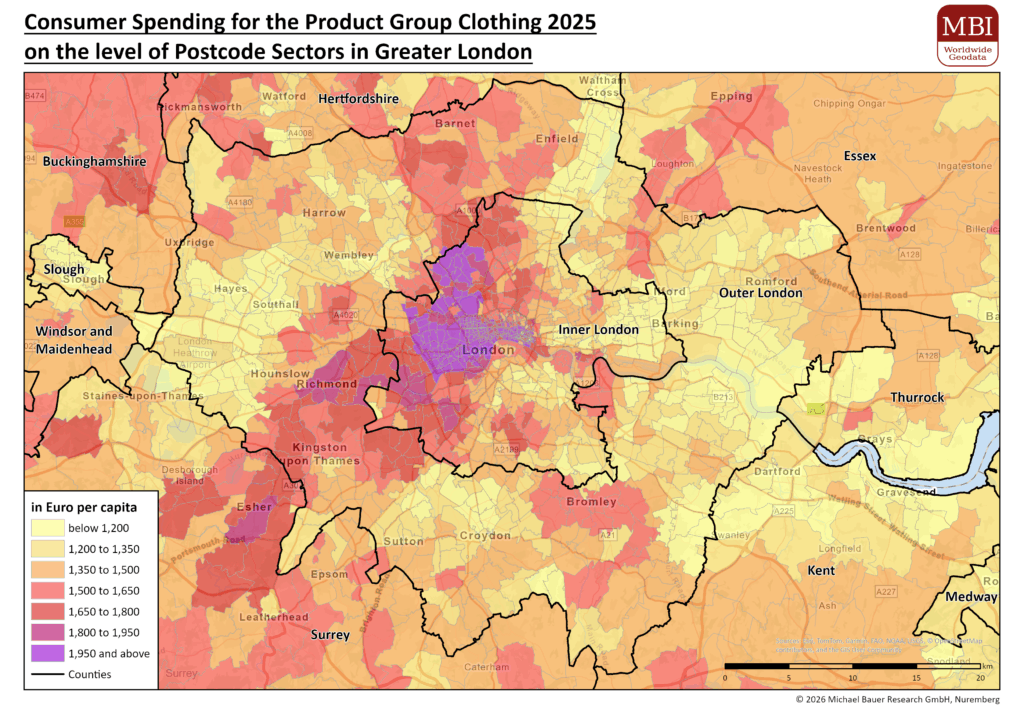
These examples demonstrate how MBI’s European Market Data goes beyond general statistics. It enables fine-grained retail planning, precise catchment analysis, and targeted expansion strategies based on measurable local demand.
Built for Real-World Business Applications
The release 2026 supports a wide range of strategic and operational use cases. Companies can rely on it for site and expansion planning, identifying optimal store locations based on real regional demand patterns. It strengthens catchment area analysis by combining purchasing potential with demographic structure, and it enhances target group marketing through precise regional segmentation.
Media planning and direct marketing activities also benefit from granular insights into spending behavior and population characteristics. For organizations working in geospatial analytics and location intelligence, the harmonized European coverage ensures a stable and comparable foundation for advanced spatial modeling.
Seamless Integration with Digital Boundaries
All European Regional Market Data is fully compatible with the latest MBI Boundaries. This ensures straightforward integration into GIS platforms, business intelligence systems, and mapping applications. Statistical indicators align directly with boundary files, enabling immediate visualization and spatial analysis without complex preprocessing. The result is a streamlined workflow from data acquisition to insight generation.
Why Choose MBI for European Market Analysis?
With the 2026 release, MBI continues to provide detailed and consistent regional datasets available across Europe. The combination of microgeographic resolution, standardized indicators, and broad geographic coverage empowers companies to transform complex regional information into actionable strategy.
Businesses operating across European markets can rely on MBI’s latest release to uncover growth potential, refine targeting strategies, and strengthen location-based decision-making in 2026 and beyond. For more information, please feel free to contact our Sales Team.